

When I was comparing Strands to OpenAI Agents a few months ago, I wanted to compare how well the agents responded, a job often reserved for evaluation frameworks. The caveat: running Strands through Strands Evals and OpenAI Agents through OpenAI Evals does not yield an exact comparison. Without a shared evaluation setup, performance differences could be due to the agents’ behaviors or to evaluation discrepancies.
Today, Strands Evals is simplifying cross-framework comparison for scenarios like the above. It now supports traces emitted from several new agent frameworks, including those following GenAI semantic conventions. This is part of a larger initiative to make Strands Evals framework-agnostic. The table below shows the updated agent framework and tracing combinations Strands Evals supports. Built-in refers to the framework’s native OTel tracing. OpenInference and Traceloop are third-party instrumentor libraries that hook into agent frameworks to produce OTel spans.
| Agent Framework | Built-in | OpenInference | Traceloop |
|---|---|---|---|
| Strands | ✓ | — | — |
| Claude Agents SDK | — | ✓ | — |
| Google ADK | ✓ | — | — |
| OpenAI Agents SDK | — | ✓ | ✓ |
| LangChain | — | ✓ | ✓ |
| Smolagents | — | ✓ | — |
| Pydantic AI | ✓ | — | — |
| AutoGen | ✓ | — | — |
In this post, I will discuss why framework-agnostic evaluation matters and how to start using Strands Evals to evaluate agents from a variety of frameworks, including Claude Agents, OpenAI Agents, and Google ADK.
Where framework-specific evaluation falls short
Many agent frameworks ship with native evaluation tools.
- LangChain and LangSmith
- Google ADK and Gen AI Evaluation Service
- Microsoft AutoGen and Azure AI Evaluation SDK
- Pydantic AI and Logfire
They offer feature-rich evaluation tailored to their native framework. While framework-specific tools handle their own frameworks well, they face challenges when evaluating agents from other frameworks. Agent frameworks often differ in instrumentation (the hooks emitting information about what the agent did) and in the subsequent span format. Evaluating an agent from one framework in another vendor’s tool requires span format compatibility, or manual conversion.
An alternative is to use a different evaluation tool for each agent framework, sidestepping the compatibility issues. But this approach does not scale. When you switch frameworks, you must also learn how to use a new evaluation tool.
What framework-agnostic evaluation provides
A framework-agnostic evaluation solves the issues above through greater interoperability:
- You define your cases and evaluators once. When you try a new agent framework, you swap the agent code and keep everything else the same.
- Comparisons become apples-to-apples: same cases, same evaluators, same scoring. This ensures differences in results come from the agents, not the evaluation setup.
- Switching costs drop because you learn one evaluation tool and bring it with you as you change frameworks.
How Strands Evals bridges frameworks
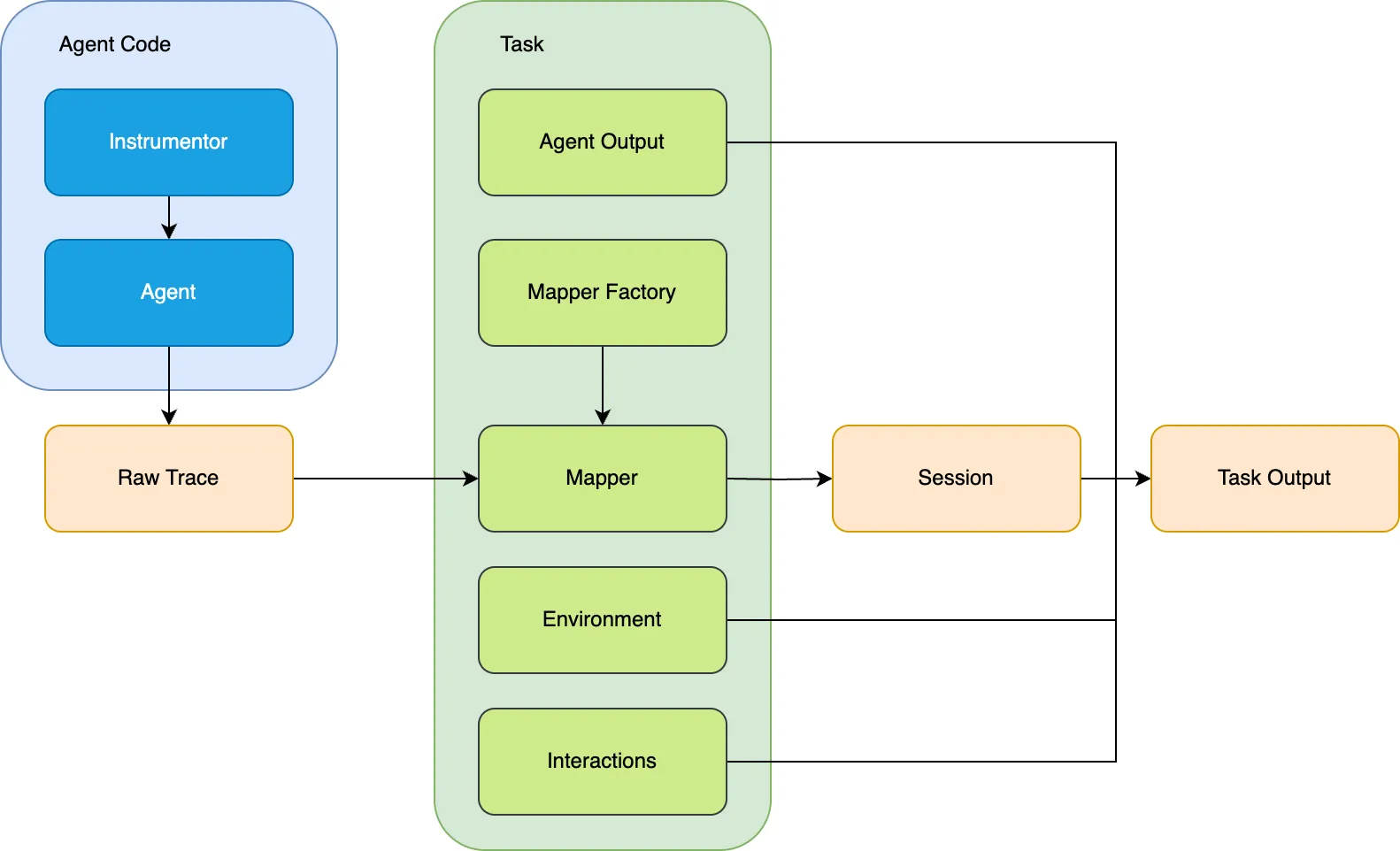
Figure 1: The user-defined task converts raw traces into sessions using mappers and assembles the task output
Strands Evals handles other agent frameworks using session mappers: adapters that convert raw
spans into unified session objects. Sessions represent the agent’s trajectory (a record of what
the agent did) in a standardized format and comprise a major part of the TaskOutput. From here,
Strands Evals works the same as with a native Strands agent. The remaining TaskOutput fields,
output, interactions, and environment, are user-defined and vary by experiment.
In practice, session mappers are called inside user-defined task functions. These tasks run the
agent, collect the emitted trace spans, and assemble the TaskOutput. Strands Evals provides a
factory function that facilitates this: it inspects span scopes and selects the appropriate
mapper automatically, making the same mapping logic reusable across multiple agent frameworks.
Walkthrough: evaluating a commit message agent
The following sections walk through how to evaluate an agent built with Claude Agents SDK using Strands Evals, demonstrating cross-framework support. The example agent writes commit messages, a repetitive task fit for an agent. You can find the full example here.
This walkthrough assumes familiarity with Strands Evals. If you are new, see the Strands Evals quickstart for a quick tour.
Prerequisites
- Python 3.10 or later.
- An AWS account with access to Amazon Bedrock.
- AWS credentials configured locally (for example, via
aws configureor an IAM role) with Amazon BedrockInvokeModelpermission for the judge model.
Install the dependencies:
pip install strands-agents-evals claude-agent-sdk openinference-instrumentation-claude-agent-sdkStep 1: Set up instrumentation
The first step is instrumentation. We use OpenInference, which hooks into the Claude Agents SDK
and produces OTel spans collected in-process with InMemorySpanExporter.
from openinference.instrumentation.claude_agent_sdk import ClaudeAgentSDKInstrumentorfrom strands_evals.telemetry import StrandsEvalsTelemetry
telemetry = StrandsEvalsTelemetry().setup_in_memory_exporter()ClaudeAgentSDKInstrumentor().instrument()
Step 2: Define the agent
Define a commit message agent using the Claude Agents SDK.
from claude_agent_sdk import ClaudeAgentOptions, ResultMessage, query

async def run_commit_agent(diff: str) -> str:    options = ClaudeAgentOptions(        allowed_tools=["Bash"],        max_turns=3,        system_prompt=(            "Write a conventional commit message for the given diff. "            "Format: <type>(<scope>): <subject>. "            "Types: feat, fix, docs, style, refactor, perf, test, chore. "            "Imperative mood, lowercase, no period. Output only the commit message."        ),        env={            "CLAUDE_CODE_USE_BEDROCK": "1",            "ANTHROPIC_MODEL": "us.anthropic.claude-sonnet-4-6",            "AWS_REGION": "us-east-1",        },    )    result = ""    async for msg in query(        prompt=f"Generate a commit message for this diff:\n\n{diff}",        options=options,    ):        if isinstance(msg, ResultMessage) and msg.subtype == "success":            result = msg.result
    return result.strip()
Step 3: Wire up the experiment
The task function runs the agent, converts the collected spans into a session object, and builds
the TaskOutput for evaluation. The critical line is detect_otel_mapper(spans). It inspects
the span scopes, recognizes Claude Agents traces, and returns the appropriate mapper. You never
have to specify the framework mapper manually.
import asynciofrom typing import Any
from strands_evals import Case, Experimentfrom strands_evals.evaluators import HelpfulnessEvaluator, GoalSuccessRateEvaluatorfrom strands_evals.mappers import detect_otel_mapper, readable_spans_to_dicts

async def task(case: Case) -> dict[str, Any]:    telemetry.in_memory_exporter.clear()
    response = await run_commit_agent(case.input)    telemetry.tracer_provider.force_flush()
    spans = readable_spans_to_dicts(telemetry.in_memory_exporter.get_finished_spans())    session = detect_otel_mapper(spans).map_to_session(spans, session_id=case.session_id)    return {"output": response, "trajectory": session}
With the task function in place, wire up the rest of the experiment. One case carries an
expected output for comparison. HelpfulnessEvaluator scores whether the response addressed
the user’s need, while GoalSuccessRateEvaluator scores whether the user’s overall goal was
achieved.
experiment = Experiment(    cases=[        Case(            name="fix-null-check",            input=(                "# src/user.py\n"                "-    return user['name'].upper()\n"                "+    if not user or 'name' not in user:\n"                "+        return 'Anonymous'\n"                "+    return user['name'].upper()\n"            ),            expected_output="fix(user): handle missing user or name field in get_display_name",        ),    ],    evaluators=[HelpfulnessEvaluator(), GoalSuccessRateEvaluator()],)
async def main():    report = await experiment.run_evaluations_async(task)
    for case, score, passed, reason in zip(report.cases, report.scores, report.test_passes, report.reasons):        status = "PASS" if passed else "FAIL"        print(f"[{status}] {case['name']} ({case['evaluator']}): {score:.2f}")        print(f"  Reason: {reason}\n")
asyncio.run(main())
Step 4: Inspect the results
Running the experiment produces:
[PASS] fix-null-check (HelpfulnessEvaluator): 0.83  Reason: The assistant provided a concise, well-formatted commit message that correctly  identifies the change as a "fix", scopes it to "user", and accurately describes what  the change does. The commit message is accurate, appropriately formatted, and directly  addresses what the user asked for.
[PASS] fix-null-check (GoalSuccessRateEvaluator): 1.00  Reason: A commit message was provided and confirmed to follow Conventional Commits format.  The user's goal of getting a commit message for the diff has been satisfied.
The output format is identical to what you would see when evaluating a native Strands agent. Swap in a different framework and compare results directly, knowing the scoring methodology stayed constant.
Variation: OpenAI Agents
The following example swaps Claude Agents for OpenAI Agents to evaluate the same commit message task, illustrating what changes and what remains the same. Once again, you can find the full example here.
Obtain an OpenAI API key and set it in your environment variables. You also need the following dependencies:
pip install openai-agents openinference-instrumentation-openai-agentsSet up the OpenInference instrumentor and in-memory exporter as before:
from strands_evals.telemetry import StrandsEvalsTelemetryfrom openinference.instrumentation.openai_agents import OpenAIAgentsInstrumentor
telemetry = StrandsEvalsTelemetry().setup_in_memory_exporter()OpenAIAgentsInstrumentor().instrument()
Define an agent with OpenAI Agents SDK’s Agent class and its executor with Runner.
from agents import Agent, Runner

commit_agent = Agent(    name="commit_agent",    model="gpt-5.6-sol",    instructions=(        "Write a conventional commit message for the given diff. "        "Format: <type>(<scope>): <subject>. "        "Types: feat, fix, docs, style, refactor, perf, test, chore. "        "Imperative mood, lowercase, no period. Output only the commit message."    ),)

async def run_commit_agent(diff: str) -> str:    result = await Runner.run(        commit_agent, f"Generate a commit message for this diff:\n\n{diff}"    )    return result.final_output.strip()
No additional changes are needed. The task function, cases, evaluators, and reporting code
remain the same as the Claude Agents example. detect_otel_mapper recognizes OpenAI Agents SDK
spans by their scope and selects the correct mapper automatically.
Strands Evals also supports OpenAI Agents instrumented with Traceloop. Swap the instrumentor in the first step and the rest of the setup stays the same.
pip install opentelemetry-instrumentation-openai-agentsfrom opentelemetry.instrumentation.openai_agents import OpenAIAgentsInstrumentor
OpenAIAgentsInstrumentor().instrument()Evaluating production traces from AgentCore
The previous examples collected traces in-process using an InMemorySpanExporter. In
production, your agents may run on managed infrastructure, where traces flow through
observability pipelines. One such example is Amazon Bedrock AgentCore, which supports various agent frameworks
and exports OTel traces to Amazon CloudWatch via an ADOT (AWS Distro for OpenTelemetry) collector.
Despite these differences, Strands Evals evaluates CloudWatch spans in the same way as in-process ones.
To demonstrate that Strands Evals can evaluate non-AWS agent frameworks deployed on AWS infrastructure, this section deploys a Google ADK commit message agent to AgentCore, retrieves its production traces from CloudWatch, and runs them through the same Strands Evals experiment used in the earlier examples.
In addition to the prerequisites from earlier, you need:
- Node.js 20+ installed.
- AWS CDK installed.
- A Google API key.
- AWS credentials with permissions to deploy to AgentCore Runtime and query CloudWatch Logs
(
logs:StartQuery,logs:GetQueryResults). For the full list, see AgentCore CLI permissions. - Amazon CloudWatch Transaction Search enabled in your account.
Install the AgentCore CLI:
npm install -g @aws/agentcoreStep 1: Set up the AgentCore project
Use the AgentCore CLI to scaffold a Google ADK project. The CLI generates the project structure, agent code, and deployment configuration.
agentcore create \  --name CommitAgent \  --framework GoogleADK \  --model-provider Gemini \  --memory none \  --api-key <YOUR_GEMINI_API_KEY>
cd commit-agent
The scaffolded project includes a starter agent in app/CommitAgent/main.py. Update the tools
and system prompt to match the commit message task from the previous examples.
tools = []
AGENT_INSTRUCTION = (    "Write a conventional commit message for the given diff. "    "Format: <type>(<scope>): <subject>. "    "Types: feat, fix, docs, style, refactor, perf, test, chore. "    "Imperative mood, lowercase, no period. Output only the commit message.")
Step 2: Deploy and invoke the agent
Deploy the agent to AgentCore Runtime:
agentcore deployWith the agent deployed, invoke it to generate production traces. AgentCore exports the resulting OTel spans to CloudWatch automatically.
agentcore invoke "Generate a commit message for this diff: - return user['name'].upper() + if not user or 'name' not in user: + return 'Anonymous' + return user['name'].upper()"Take note of the session ID in the output:
Session: 5f630229-bb19-4fae-bcdd-ec335218f531Step 3: Evaluate the agent
To pull traces from CloudWatch into Strands Evals, create a CloudWatchProvider pointing at
the deployed agent. The provider handles querying CloudWatch, retrieving spans, and mapping them
from ADOT format into session objects. No manual trace conversion is needed.
from strands_evals.providers import CloudWatchProvider
provider = CloudWatchProvider(agent_name="CommitAgent_CommitAgent")
The experiment setup is the same as the in-process examples. Define cases, attach evaluators,
and call run_evaluations. Instead of passing a custom task function, pass
provider.as_task(), which retrieves production traces by session ID and returns the
TaskOutput for evaluation.
from strands_evals import Case, Experimentfrom strands_evals.evaluators import GoalSuccessRateEvaluator, HelpfulnessEvaluator
SESSION_ID = "<your-session-id>"
cases = [    Case(        name="cloudwatch-session",        input=(            "Generate a commit message for this diff:"            "# src/user.py\n"            "-    return user['name'].upper()\n"            "+    if not user or 'name' not in user:\n"            "+        return 'Anonymous'\n"            "+    return user['name'].upper()\n"        ),        session_id=SESSION_ID,    ),]
experiment = Experiment(    cases=cases,    evaluators=[HelpfulnessEvaluator(), GoalSuccessRateEvaluator()],)
async def main():    report = await experiment.run_evaluations_async(provider.as_task())
    for case, score, passed, reason in zip(report.cases, report.scores, report.test_passes, report.reasons):        status = "PASS" if passed else "FAIL"        print(f"[{status}] {case['name']} ({case['evaluator']}): {score:.2f}")        print(f"  Reason: {reason}\n")
asyncio.run(main())
The evaluators score the production traces the same way they scored the in-process traces from
the earlier examples. CloudWatchProvider handles trace retrieval and mapping internally,
using the same detect_otel_mapper mechanism under the hood.
Supported observability backends
Strands Evals supports several observability backends through trace providers. A provider
connects to a backend, retrieves spans by session ID, and maps them into a TaskOutput using
the same session mappers described earlier.
Amazon CloudWatch is for agents deployed on Amazon Bedrock AgentCore or any environment that exports OTel spans to CloudWatch Logs. It runs a CloudWatch Logs Insights query filtering by session ID, parses the raw log records into normalized span dictionaries, and selects the correct mapper based on span scope names.
from strands_evals.providers import CloudWatchProvider
provider = CloudWatchProvider(agent_name="my-agent")
# Or point directly to a log groupprovider = CloudWatchProvider(    log_group="/aws/bedrock-agentcore/runtimes/MyAgent-abc123-DEFAULT",    # Use shared span log group if AgentCore project uses split telemetry (UNIFIED_TRACES_DESTINATION_ENABLED=false)    # log_group="aws/spans",    lookback_days=7,)
Langfuse is for agents instrumented with any OTel-compatible framework and exporting to Langfuse. It fetches traces by session ID via the Langfuse API and converts Langfuse’s native observation spans into evaluation sessions.
from strands_evals.providers import LangfuseProvider
# Credentials from env: LANGFUSE_PUBLIC_KEY, LANGFUSE_SECRET_KEYprovider = LangfuseProvider()
# Or explicitprovider = LangfuseProvider(    public_key="pk-...",    secret_key="sk-...",    host="https://us.cloud.langfuse.com",)
Conclusion
With framework-agnostic evaluation, you define your cases and evaluators once, swap in a different agent, and compare results directly. The scoring methodology stays constant, so differing results only reflect differences in the agents. Whether you are choosing your first agent framework or comparing several in production, framework-agnostic evaluation gives you one tool that follows you.
While Strands Evals strives to be framework-agnostic and supports a healthy range of frameworks, note that it is still in active development. If you find traces that are converted incorrectly or contain scopes unrecognized by the mapper factory, cut us an issue in the evals repository.
Start evaluating your agents today:
pip install strands-agents-evalsThen explore the resources below:
- Read the Strands Evals documentation for a deeper look at evaluation features.
- Try the cross-framework examples.
- See Remote Trace Providers for full configuration options for providers.